


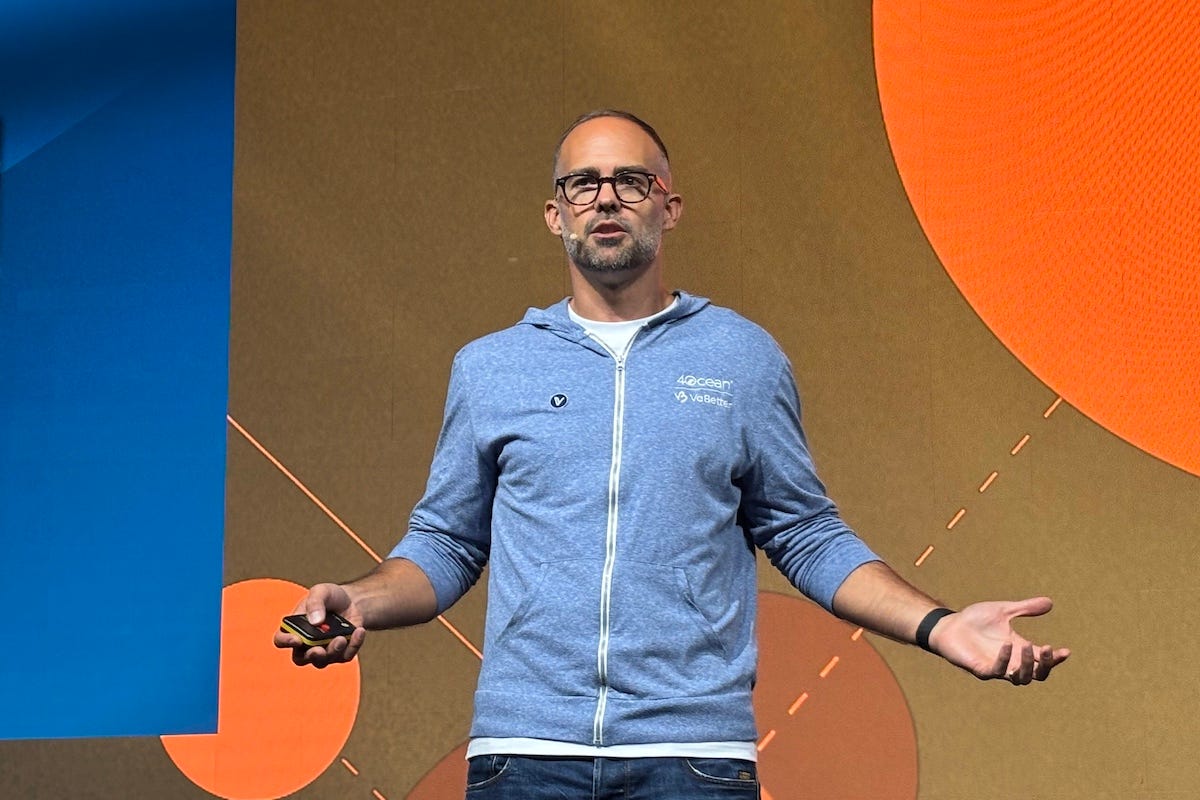
Automated AI-driven systems now coordinate verification, value transfer and user engagement across consumer applications, transforming blockchain into invisible everyday infrastructure
Empowering mobile apps with automated intelligence and seamless on‑chain execution is rapidly shifting blockchain from an experimental toolset into an invisible infrastructure layer.
The rise of agentic artificial intelligence is accelerating a new model of digital interaction, one in which automated systems handle verification, value transfer, and decision‑making across multiple consumer applications.
In this emerging landscape, the convergence of AI and blockchain is no longer speculative. It is already present in millions of weekly transactions, embedded inside mainstream applications that reward everyday user actions.
“Blockchain and AI can be used together. They are collaborators; they are capabilities that you get to use,” said Anthony Day, Marketing Director at VeChain.
He positioned this as the foundation for how automated systems will increasingly coordinate verification, value transfer, and user interactions across consumer applications, reinforcing the article’s central theme that the technologies are advancing in tandem rather than in isolation.
As Day explained, the pace of this transition will intensify rapidly.
“The pace of technological change will never be slower than it is today. Five years from now, Siri is going to be doing a whole lot more things for you than it’s doing today,” he told the audience, adding that future AI systems will execute an increasing share of digital tasks across apps, wallets, and decentralized systems.
He also underlined the scale of momentum behind agentic systems, pointing to investment trends.
“Last year alone, $150 billion was invested in AI apps. Suffice it to say that is a very large amount of money,” he noted, arguing that these applications will soon “end up in your pocket, on your computer and in your daily life.”
This intersection of AI agents and blockchain infrastructure represents both a commercial opportunity and a structural overhaul in how enterprises build consumer services.
AI–Blockchain Infrastructure
At the London Blockchain Conference in London on October 22, Day outlined how AI agents will increasingly handle tasks that currently require manual user engagement. By moving across calendars, banking apps, social media, and on‑chain environments, these agents will coordinate workflows, verify identities, and trigger transactions without human prompts.
Day highlighted that this shift is already visible in VeChain’s ecosystem, which hosts millions of users, dozens of applications, and more than a million on‑chain actions every week. While the underlying processes rely on blockchain ledgers, identity tools, and smart contracts, users engage only with mobile experiences.
He stressed that blockchain remains invisible in the background, similar to cloud infrastructure.
“You’re not going to notice the technology on the back end,” he said. “You’re just going to say, Hey Siri, plan my day for me.”
Day then shifted to the practical convergence of AI image recognition and blockchain‑based rewards, illustrating how these technologies interact inside mainstream consumer applications. He detailed how VeChain‑powered applications use AI to validate real‑world behavior and then issue digital rewards recorded on‑chain.
Day pointed to Mugshot, an app that rewards people for using reusable coffee cups. The software uses AI to verify the image and then processes the action through the blockchain infrastructure.
“They do one million transactions where somebody is being rewarded every day for doing something sustainable, something good for themselves, for their community, or for the planet,” he said.
He also highlighted Restify, an app that rewards users for putting their phones down for a fixed time. When the device is picked up again, users receive a tokenized reward. Day explained that such apps make blockchain invisible, converting complex infrastructure into simple everyday incentives. This seamless experience creates a natural bridge to the broader ecosystem VeChain is building.
Expanding Real‑World Use Cases
To create a smoother narrative flow, this section builds directly on the earlier discussion of user‑facing applications, extending the same logic into broader organizational and commercial environments.
VeChain’s broader platform, VeBetter, functions as an app store designed for reward‑based behavior. Day emphasized that any organization could create similar experiences. Insurance firms could reward small daily actions that lower risk profiles by encouraging safer or healthier behavior through simple, verifiable tasks. Stadium operators could incentivize fans to keep venues clean, using tokenized payouts to drive operational efficiency.
He noted that VeChain’s approach focuses on measurable actions.
“We’re tokenizing karma (positive real-world actions),” Day said, describing how organizations can assign value to consistent and sustainable habits.
Another example involved a partnership with the Ultimate Fighting Championship, where users follow fitness routines from athletes and receive rewards for completing exercises. Day positioned this model as a bridge between entertainment, personal wellness, and digital engagement.
“The ability for agents to jump from one app to another, from Google to your banking app to your social media to your calendar, is going to get even bigger, faster, and more prevalent,” Day said.
He argued that the next stage of growth requires significant investment in developer tooling. He said AI agents will soon be able to identify bugs, propose improvements, and issue pull requests automatically. This will demand software systems capable of near‑instant response, creating a feedback loop where applications evolve at the pace of automated agents.
He also pointed to opportunities in marketing, analytics, security, and community management.
“These are all areas where there are huge opportunities for companies to put together these technologies to help solve problems, to help ecosystems grow, to help build better applications every day,” he said. These areas will require new frameworks that blend blockchain transparency with AI‑driven automation.
Future Applications
“Imagine a world where software infrastructure dramatically increases in quality, reach, and speed of evolution,” Day said, outlining the long‑term trajectory of agentic systems in digital commerce. He suggested that AI agents will increasingly manage wallets, execute transactions, and operate full application lifecycles, from deployment to user acquisition.
He referenced internal experiments in which an agent can create a website, launch an application on VeBetter, and promote it through social media channels.
“It is feasible today that an agent could capture funds, build a website, build an application on VeBetter, launch it, and do its own social media to recruit other users,” he said. He argued that this level of autonomy will become standard as digital ecosystems mature.
He encouraged developers to pursue new application models across sustainability, consumer rewards, and real‑world data networks, emphasizing that these domains present immediate opportunities for practical innovation.
In closing, Day pointed attendees toward the VeBetter white paper, which outlines a vision for an “agentic future” that tightly integrates blockchain capabilities with AI‑driven applications.
As enterprises assess the next evolution of customer engagement, Day’s message underscored a broader shift in digital infrastructure. AI agents are set to transform how organizations serve users, manage data, and coordinate value transfer. And as these systems scale, the underlying blockchain mechanisms will remain quietly embedded—powering millions of daily actions without ever appearing on the user’s screen.