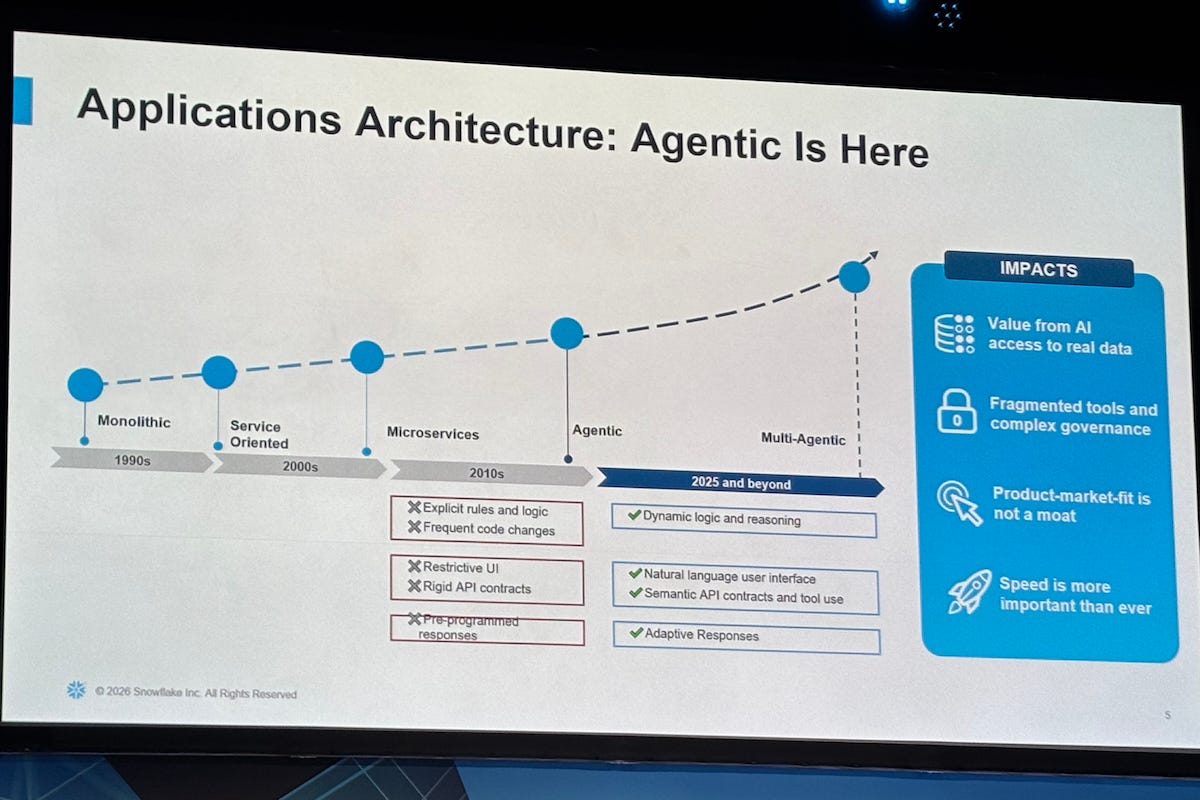
Enterprise software is entering a new phase as artificial intelligence (AI) moves beyond rule-based systems into agent-driven architectures that can reason across data, tools, and workflows. The shift replaces rigid, deterministic logic with probabilistic systems that demand new design and operating models.
Instead of relying on predefined rules and APIs, enterprises are adopting natural-language-powered orchestration layers. These systems allow applications to interpret context and act across multiple data sources in real time. As adoption accelerates, AI is moving into core business processes—while exposing structural challenges around data fragmentation, governance and scalability.
“Building applications has changed quite a lot in the last five years. You went from very stiff if-then logic, a lot of APIs and code rules, and now that we’ve entered the age of agentic applications, it’s completely different,” said Grace Adamson, AI Senior Product Marketing Manager at Snowflake.
“All of a sudden, you have this orchestration layer that can use natural language, isn’t restricted to if-then logic, but can still connect and orchestrate across all your data,” she said.
The shift is forcing enterprises to confront a fundamental constraint: AI systems are only as effective as the data they can access and interpret. As organizations scale AI across departments, fragmented datasets and inconsistent context are emerging as key barriers to reliable outcomes.
“Your agent is only really as good as the data it has access to,” Adamson said. “Every organization is trying to scale AI through all the enterprise applications. This means a lot of disconnected data points and disconnected context.”
At the same time, the rise of agentic systems is reshaping how enterprises think about security and control. Traditional governance models, designed around human users, are being reconfigured to accommodate autonomous agents acting on behalf of users and systems.
“All of this still needs to be in the same security perimeter, and all of that is compounded even more complicated if you think about setting up policies that used to be by person, and now all of that is by agent object instead,” Adamson said.
The shift toward agent-level governance introduces new operational complexity, particularly in regulated sectors where traceability, auditability, and access control are critical. Enterprises must now track not only who accessed data but also which agent performed actions, what context was used, and how decisions were made.
Inside the build
Snowflake is a cloud-native data platform that enables enterprises to consolidate, process, and analyze data across multiple environments, while increasingly embedding artificial intelligence and machine learning capabilities directly into its architecture.
This positioning reflects a broader industry push to operationalize AI within core data infrastructure rather than treating it as a separate layer.
This shift—from rule-based systems to agent-driven orchestration, alongside growing concerns around data fragmentation and governance—was a central focus at Snowflake BUILD: The Dev Conference for AI & Apps, held in London on February 5, where executives outlined how agentic architectures are moving from experimentation into production environments.
Adamson focused on the conceptual framework behind agentic applications, while Teresa Nascimento, Senior Solution Engineer at Snowflake, demonstrated how such systems are implemented and deployed in enterprise settings.
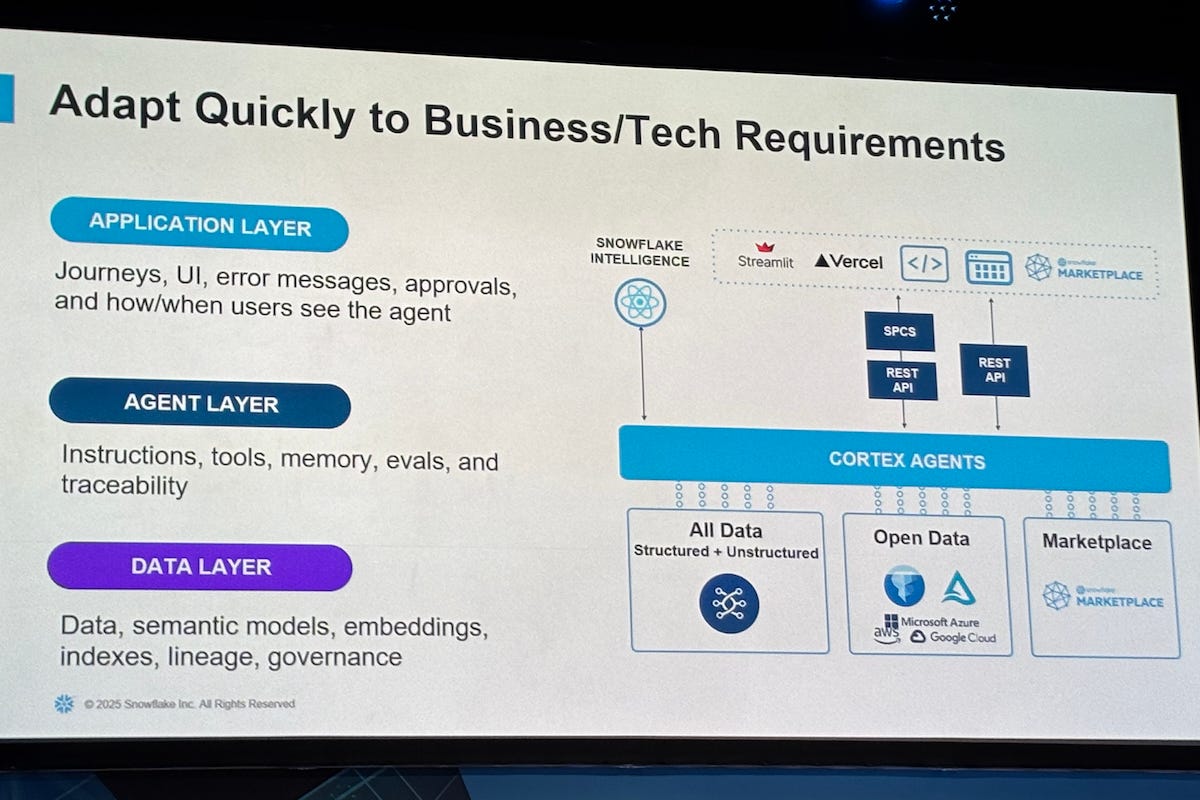
Nascimento outlined a three-layer architecture:
Data layer integrating structured and unstructured sources
Agent layer responsible for reasoning and orchestration
Application layer that interfaces with users
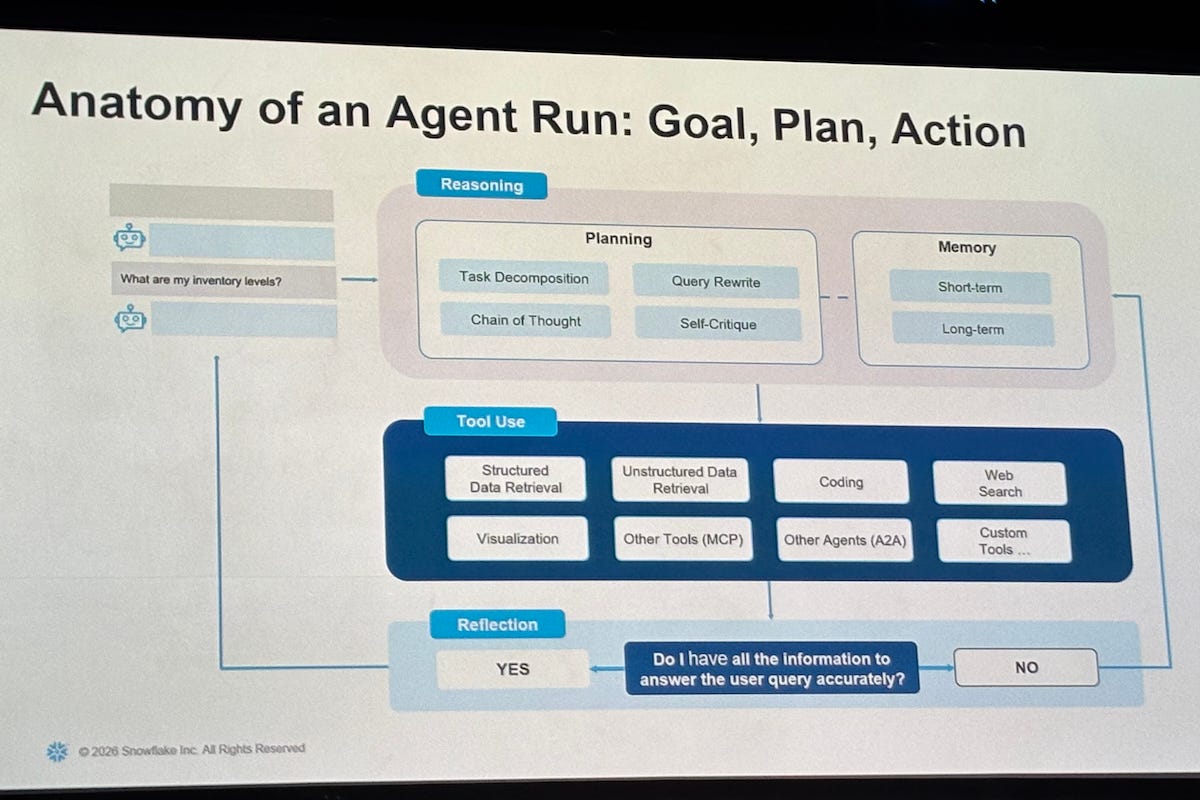
At the core is the ability to combine context with action. In one example, a dispute-resolution agent aggregated customer data, transaction records, and unstructured documents to generate recommendations and risk assessments.
“You add those instructions here to make your agent less probabilistic and more deterministic when it’s posed with a question,” she said.
Tools and control
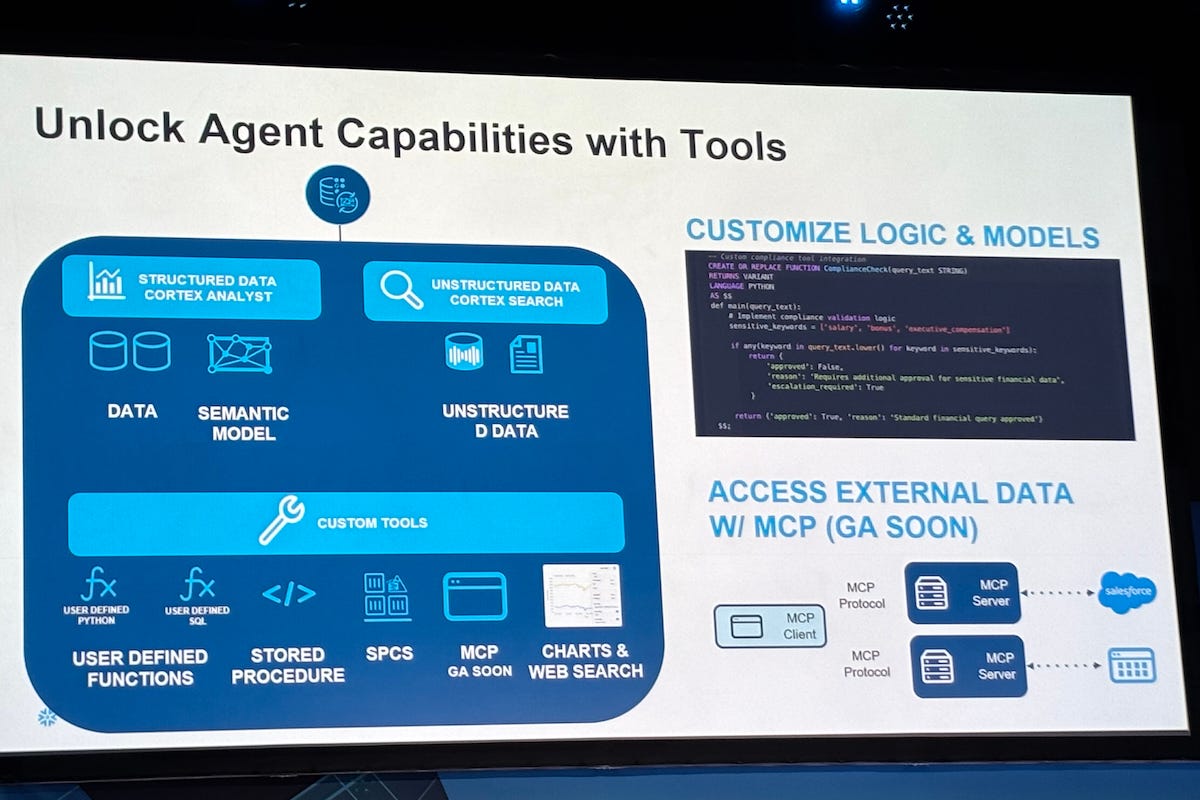
A key focus of the discussion was the role of tools in making AI systems reliable enough for enterprise use. While agents are inherently probabilistic, integrating predefined functions and domain-specific logic can introduce deterministic behavior.
“When you start to create these customized tools, you’re turning a probabilistic workflow into something that has more deterministic features and functions,” Adamson said.
These tools range from simple user-defined functions to complex machine learning models deployed through container environments. By embedding these capabilities into agents, organizations can constrain outputs, enforce business logic, and improve consistency.
“What we recommend at Snowflake is having an agent that’s incredibly specific, so specific agents for specific tasks,” she said. “This is where we’re seeing a lot of improvements in quality.”
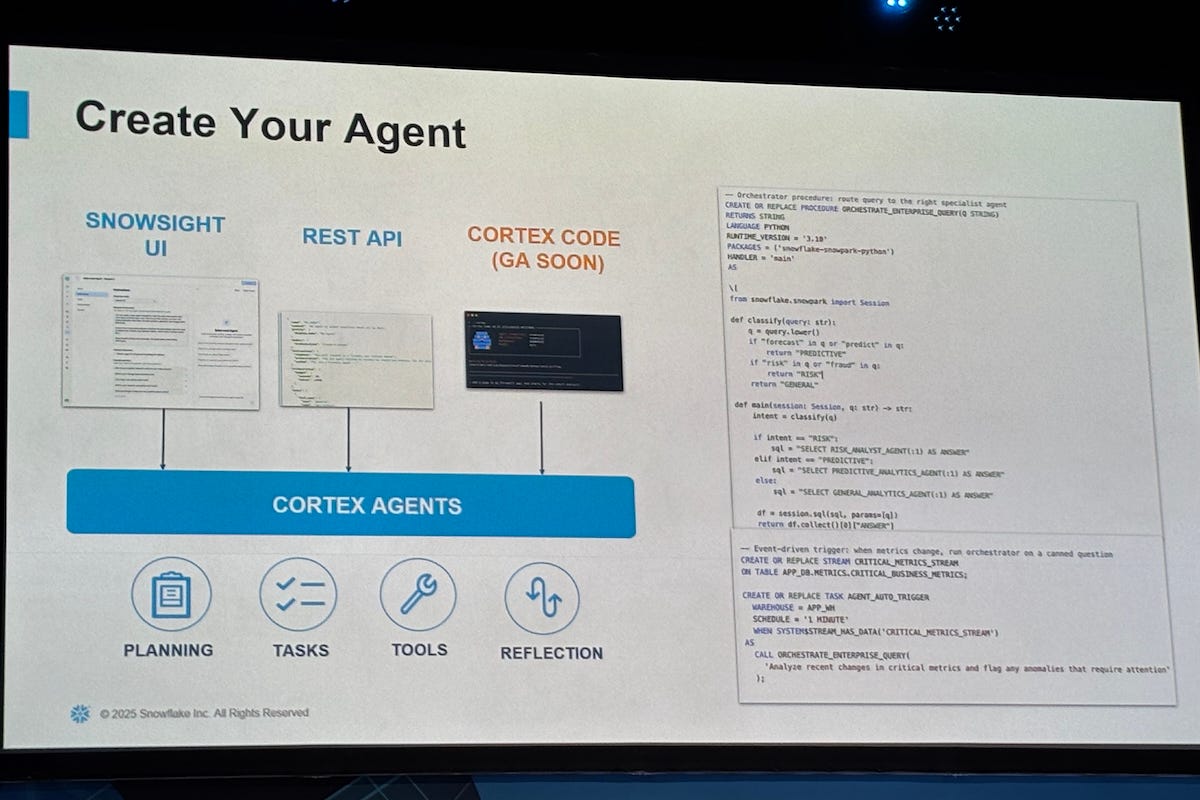
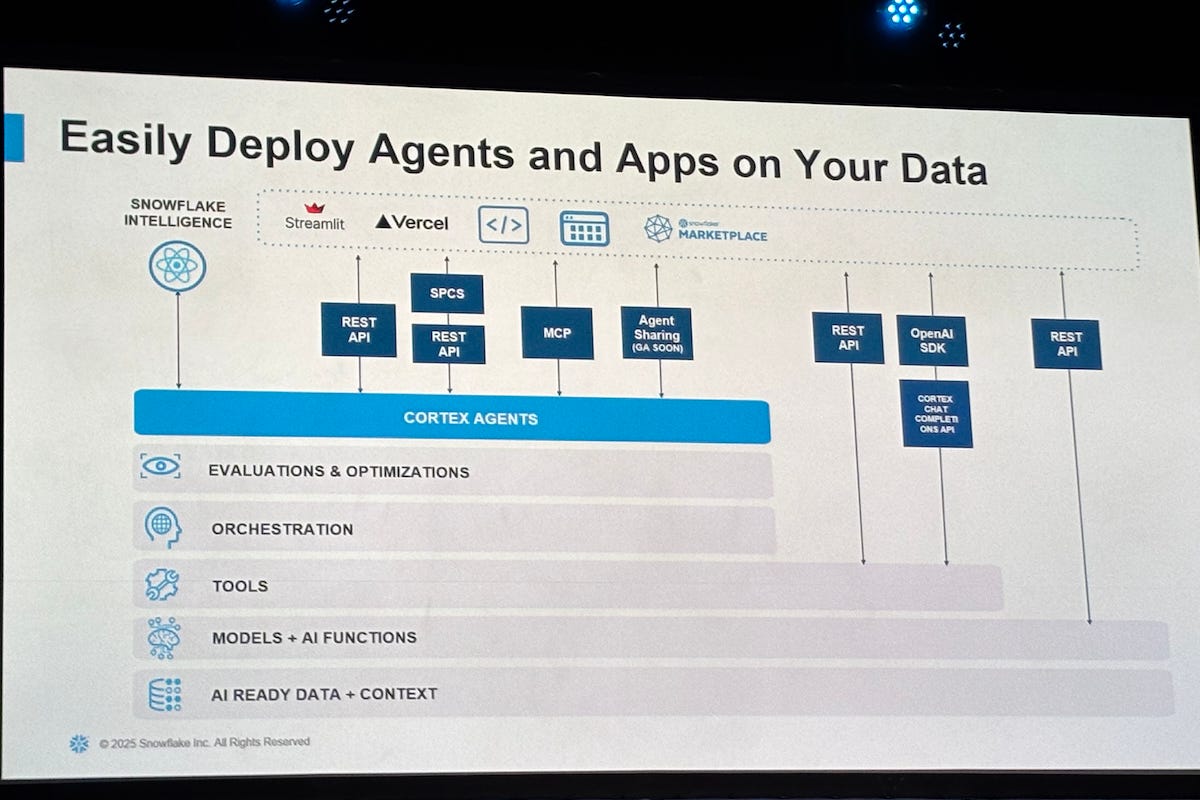
Nascimento showed how developers can connect agents to applications via APIs, passing contextual data and instructions to control how responses are generated and formatted. This allows enterprises to tailor outputs to specific use cases, such as compliance workflows or financial analysis.
“You can add as many tools as you want to your agent,” she said.
The increasing use of modular tools is also driving a shift away from general-purpose AI toward specialized, domain-focused agents designed for specific tasks.
Scaling challenge
Despite rapid progress in development tools, the transition from prototype to production remains a hurdle. Building an agentic application can be straightforward, but scaling it across thousands of users introduces new operational demands.
“It is easy to build an agent. It is easy to build an application, but then scaling that application takes a lot of work,” Adamson said.
To address this, vendors are introducing capabilities such as version control, monitoring, and evaluation metrics that track how agents perform over time. These features are critical for ensuring reliability, especially as agents interact with live data and business processes.
“You’re now able to evaluate that across not just in testing… but after deployment as well,” she said.
Looking ahead, the enterprise focus is shifting toward making agentic systems production-ready, balancing flexibility with control, and automation with accountability. As organizations deepen their use of AI, the ability to orchestrate data, tools, and governance at scale is likely to become a defining factor in competitive advantage.